
Countries such as USA, UK, Canada, Australia, and Singapore have already issued advisories to its citizens to exercise maximum caution while flying to India due to the threat of terrorist attacks and violent crimes. Governments have been forced to take this decision in the wake of ‘Operation Sindoor’ and unsafe international flights from India. After the horrific Air India flight AI171 crash in Ahmedabad that killed 271 passengers, there have been many nervous moments for the aviation industry, with Vienna-bound AI187 plunging 900 feet mid-air after taking off from Indira Gandhi International (IGI) airport as the latest hazard.
Rising per capita incomes have given several Indian citizens the opportunity to travel abroad, whether for leisure or for education. Numerous beautiful locations within India, both regular and offbeat, have also promoted increased travel within the country. But if every trip makes the flyer question whether it is really safe to fly or not, would he or she want to undertake travel? Probably not.
What about international flights to India?
Mind you, the problems seen here could happen at any time and are not related to the current situation. Belonging to Ethiopian Airlines, the ET640, a Boeing 787-9 Dreamliner, had to make an emergency landing in Mumbai on the morning of 27th June 2025 due to cabin depressurisation. On the other hand, Dreamliners are rapidly turning into an Achilles heel for the Boeing group as two more of these, bound for Chennai from London and for Delhi from Hongkong, developed technical snags before takeoff on 15th June 2025. While the Chennai flight reported a ‘flap adjustment failure’, the exact snag in the Delhi flight is unknown.

Results of safety audit by DGCA
Don’t worry, our aim at Trawheeling is not to scare you out of your wits and prevent you from flying, but to tell you the real picture. Upon carrying out a safety audit of aircrafts, airports, and maintenance firms, the Directorate General of Civil Aviation (DGCA) found troubling issues such as aircrafts flying with unresolved defects, ground equipment in bad shape, ignored work orders, and worn-out tyres. Maintenance issues were seen at airports and improper signals were observed on the runways.
After reading about the above, if you are feeling a little wary or frustrated about air travel, it is perfectly logical. If the thought of embarking on a much-awaited vacation that could be unsafe to say the least is bothering you, we completely understand. We know that the travel need should not be supressed as far as possible, which is why we want to propose that you travel, BY ROAD.
Is an international road trip feasible?
Just like any other type of travel, an international road trip also needs to be planned as much as possible. If you have 10-15 days on hand, it would be better to indulge in international road trips from India to Nepal, or India to Bhutan.
There are three international borders to cross into Nepal from India – Uttarakhand (Banbasa), Uttar Pradesh (Sunauli), Bihar (Raxaul), and West Bengal (Panitanki). Though basic documents like an Aadhar Card or driving license will be necessary, you need not carry the passport. A vehicle permit, known as ‘Bhansar’, would be required to drive in Nepal. A Yataayat Anumati, or vehicle permit, will also need to be collected at the border crossing.
Compared to the above, the requirements are more stringent for Bhutan. The documents needed to drive from India to Bhutan include a valid driving license, vehicle insurance, RC, PUCC, an ID proof such as passport, hotel booking, and an entry permit that can be bought at Phuentsholing. To travel beyond Paro and Thimpu, you will need a road permit and the services of a guide.
Other than Nepal and Bhutan, it is also possible to drive to countries such as Thailand, China, and Russia. However, the prices will be more than what you would pay at Nepal and Bhutan. But if you have the time and the willingness, the driving experience will make the trip truly memorable.
Advantages of road trips over flights
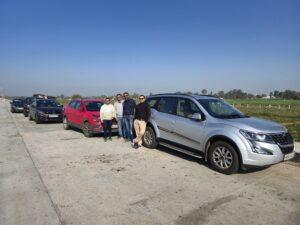
Are there any fundamental reasons to choose roads over flights? Considering the standard of highways such as NE3, NE1, NE4, NH1, and many more, road travel has become a lot more comfortable over the years. The Delhi-Mumbai expressway (NE1) will become a major reason for travellers to dump flights for their private vehicles by December 2025. Here are the advantages that expressways such as these offer:
Step out and witness scenic landscapes: Only on a road trip can you stop your vehicle and soak in the landscapes outside every now and then. You can always witness sights from your flight, but these will be like 3D images. Can you really compare them with spending time on real landscape?
Baggage restrictions: Both domestic and international flights have baggage weight limits in place. You can carry 15 kg of checked baggage and 7 kg of hand luggage across most domestic flights. International flights allow one or two checked baggage pieces of up to 23 kg and handbags from 7-10 kg. No such limits will apply when you embark on a road trip, ensuring more fulfilling trips.
Arrive early for check-in: You will have to arrive roughly 2 hours early at the airport for domestic flights and 3 hours early for international flights due to the check-in and boarding procedures. All you need to do is sit in your car and drive, and the journey will start!
Bond better: Most people only sleep, watch movies, or listen to music on flights. You’ll be able to bond better with your travel partner while on the road trip. These trips are likely to be long and will give plenty of time to talk.
Some people are also afraid of flights, thereby preferring to travel by road instead of air. Though we understand that the possibility of mishaps on the road cannot be ruled out, the latest scenario is indicative of more technical snags than accidents. Travel will not stop at any cost, which is why we feel road trips in India might just be more anxiety-free than air trips. Give yourself a chance if you haven’t tried road trips yet – we’re sure you’ll love them!