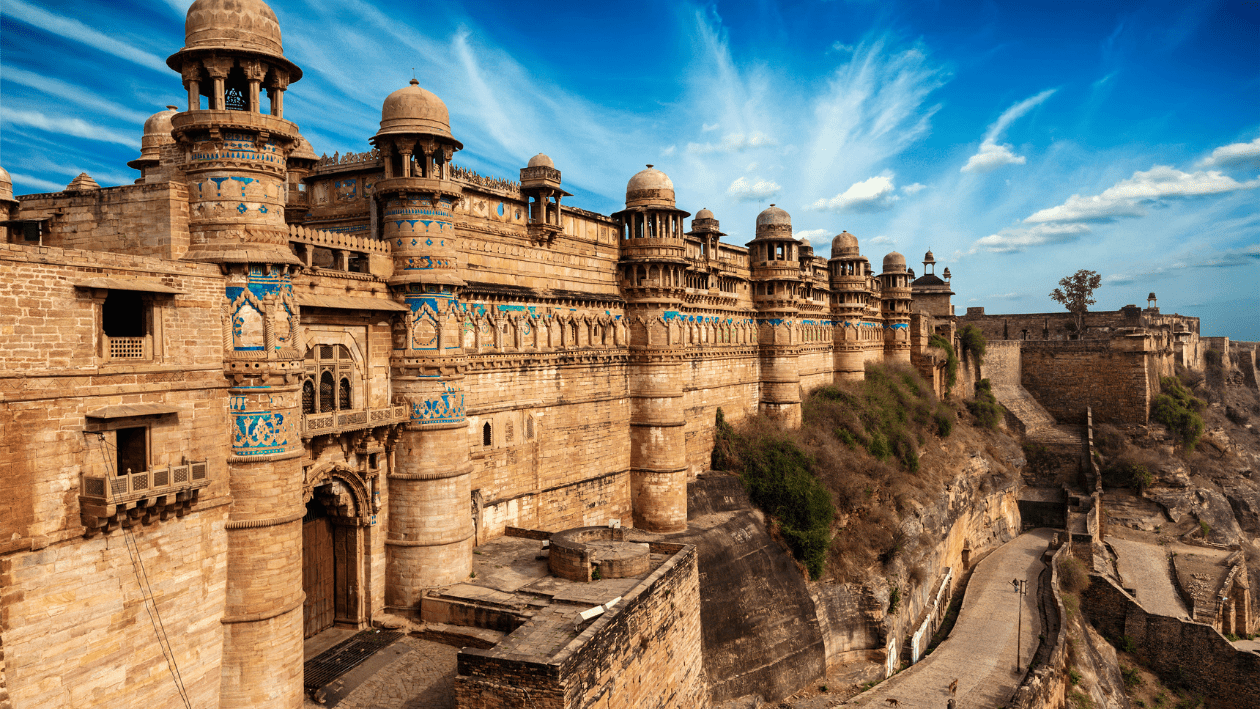
The Gwalior Fort is a popular tourist attraction since it is often regarded as one of the most stunning fortifications in India. The walls of this fort attract your attention as soon as you enter the Gwalior ka Kila complex, radiating energy that tells of the days gone in a harmonic song. Many tourists miss this castle in favor of the more popular Khajuraho-Ujjain temple circuit, but those with a genuine passion for exploring historic sites shouldn’t miss it. Find out why this fort is so unique by reading about the history of Gwalior Fort.
LEGEND & HISTORY OF GWALIOR FORT
This fort was first built in the sixth century CE. Suraj Sen, a local king then, was afflicted with leprosy and water from a holy pond was brought to him by Gwalipa, a traveling sage. The king’s illness was miraculously healed, and the monarch honored the saint by constructing a fortress. The monarch and his offspring were also given the honorific “Pal,” which means “protector of the fort,” by the holy man. Suraj Kund, the pond said to be the water source, may now be found within the fort walls.
The monarch wanted to show appreciation to the saint, so he named the castle and the town after him. Upon bestowing upon the monarch the honorific “Pal” (protector), Gwalipa assured him that the fort would stay in their hands as long as he and his descendants had this title. After Suraj Sen’s death, 83 of his descendants took over the fort. Tej Karan, the 84th king, did not deserve the title and lost the stronghold.
FORT GWALIOR: A LOOK BACK IN TIME
Historians claim they have been unable to pinpoint a specific date for the fort’s construction. Local mythology, however, claims it was constructed by a monarch named Suraj Sen in the third century CE. As explained above, Gwalipa revived the leprous monarch by giving him water from a holy pond known as Suraj Kund that was within the fort complex.
Visitors may learn about the fort’s history, which dates back to the sixth century, via inscriptions and monuments inside the structure. The Huna ruler Mihirakula formerly ruled from the fort. Gurjara-Pratiharas conquered the defence in the late 9th century, established rule, and constructed the Teli Ka Mandir, a highly revered tourist site today.
The Tomars took control of the fort in 1398 after being assaulted and held by two Muslim dynasties for three centuries. Maan Singh, the greatest and last Tomar king, built many of the monuments seen inside the fort walls. The stunning Man Mandir Palace, with its blue tilework, was constructed during his rule. In addition, he commissioned the construction of a second palace for his wife, Mrignayani, which is now a state archaeological museum known as the Gujari Mahal. The Tomars lost the fort when Ibrahim Lodi assaulted it in 1516, killing Maan Singh.
INVASION BY OUTSIDE FORCES
Despite his best efforts, attaining the Gwalior Fort was beyond Sikander Lodi in 1505. The Tomars had a reputation for bravery and would stop at nothing to defend their stronghold. After Man Singh was killed, it took a year for the Delhi Sultanate to take control over Gwalior Kila. This fort, however, fell within a decade to the expanding Mughal empire in North India. In 1542, the Delhi Sultanate and the Mughal Empire launched their dominance war, with Gwalior Kila as the ultimate prize. After a lengthy assault, Sher Shah Suri captured the whole castle.
The fort was the site of a fierce battle during the 1857 revolt, when the Queen of Jhansi, Rani Lakshmibai, fought her way from Jhansi to Gwalior. She rode her horse to the edge of the fort after days of battling with the British and jumped, ending the conflict. The Scindia family maintained control of the city and built several landmarks till India’s independence in 1947.
After a short time under Mughal control, the Gwalior Fort fell into the hands of the Marathas, who eventually ceded it to the East India Company. The Scindias, a Hindu-Maratha dynasty of Gwalior and one of East India Company’s clients, took control of the fort in 1844 and built several landmarks till India’s independence in 1947.
STRUCTURES OF RELIGIOUS SIGNIFICANCE ON THE PREMISES
The presence of several temples and monuments inside the walls of a fort makes it easy to decipher the influences of various civilizations. There are 11 Jain Tirthankara temples, the highest of which has a 58-foot-tall statue of either Rishabhanatha or Adinatha. Gwalior Kila also has the well-known Teli ka Mandir and the Tellika Temple. In the 9th century, the Gurjara-Pratihara dynasty commissioned its construction. Garuda, a monument to Lord Vishnu, is adjacent to the temple. The monument’s defining feature is that it draws equally from Hindu and Islamic architectural traditions.
A distinct group of modern-day fans of the Gwalior Fort’s palaces exist. The Man Mandir Palace, erected by Maharaja Man Singh in the 15th century, is the most visited. His successor, Kirti Singh, also pitched a palace called Karn or Karan Mahal. Vikram Mahal, the crowning architectural achievement of the Tomar dynasty, was built by Vikramaditya Singh, the oldest son of the first monarch. Saas Bahu mandir, a one-of-a-kind temple dedicated to Lord Vishnu, includes twin temples named after mother-in-law and daughter-in-law and is revered by several Hindus.
CONCLUSION
Gwalior’s central location on the prosperous Dakshinapatha trade route that linked the northern city of Taxila with the southern town of Kanchipuram made it an ideal location that connected the North India kingdoms with the ports of West and South India. The history of Gwalior Fort to these rulers will become apparent to you during today’s tour. Not only does its hilltop location provide strategic advantages, but it also exudes the pomp and circumstance befitting an imperial capital. This is important to remember since Akbar was the first Mughal ruler to convert this once-grand fortress into a jail. The Archaeological Museum on the site also has information on the numerous kingdoms that have captured the Gwalior Fort. This massive fort is spread across 3 square kilometers and rises up to 36 feet.